Whether by accident or not, Kusama discovered that through drawing and painting these experiences, she was able to gain some kind of control over them. Her mother did not share this view and violently reacted to Kusama's attempts to spend her time on art, subjecting her to torrents of physical and mental abuse.
In 1948 she left home and attended Kyoto Municipal School of Arts and Crafts for around a year and a half. She was allowed to do so under the pretext that she would study traditional etiquette at relatives in Kyoto. In 1952 she had her first solo exhibition at the Matsumoto Civic Hall. Unfortunatelly, most of the early works have been destroyed by the artist herself. At about the same time she started undergoing psychiatric treatment.
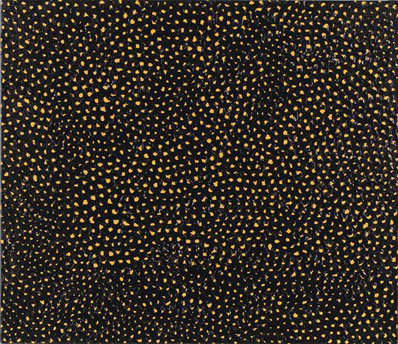
In 1957 her parents gave her money to support her moving to NYC under the condition that she would never return. She spoke little English, knew few people and had only her portfolio to aid her attempts to find work as an artist. However, by 1959 she had her first US solo exhibition, at the Brata Gallery. Furthermore, her work had clearly changed in style since her arrival in the US: from smaller, more delicate abstractions into huge mural-sized paintings. Her art revolved around the creation of repetitive images, involving polka dots and what she calls 'Infinity Nets' (a web of color stretching across canvasses and almost any object) being the most frequent patterns used.
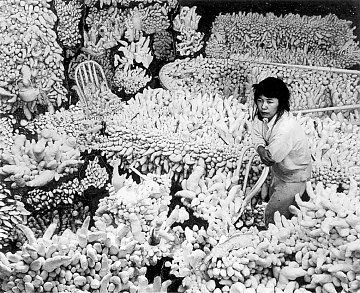
During her time in New York she met many prominent names of the 60s New York art scene, the most famous of whom would be Warhol. Her art had by now extended to sculpture and installation art, making her a pioneer. Many of her sculptures are ordinary objects completely covered with stuffed cloth phalluses (she refers to them as 'Compulsion Furniture'). For example, she covered a row-boat with these phalluses, then took a picture and made 999 prints of it. With these prints she covered all the walls of a room, placing the actual row-boat in the centre and this became her work , playing on ideas about the reproduction of art and repetition.
Kusama's work progressed onto photography and performance art. In 1967 she staged 'Body Festivals' and 'Anatomic Explosions'. These basically involved naked people and having polka dots painted on them until the police inevitably turned up. Numerous happening against the war involving naked people and public orgies followed.
In the early 70s Kusama returned to Japan. She now lives in a mental institution and has her own private studio to create work.
Themes and motivations:
Kusama calls herself an "obsessional artist", self-obsession permeates throughout Kusama's artwork as it all relates to her own attempts to come to terms with her psychological and mental condition.
Her representation of phalluses depicts her fear of obsessive sexual motifs.
"As an obsessional artist I fear everything I see. At one time I dreaded everything I was making. The armchair thickly covered in phalluses was my work done when I had a fear of sexual visions."
Infinte repetitions, patterns and ubiquitous polka dots are her favourite motifs, which she explores through painting, collage, light installations and other forms.
"A polka-dot has the form of the sun, which is a symbol of the energy of the whole world and our living life, and also the form of the moon, which is calm. Round, soft, colourful, senseless and unknowing. Polka-dots can't stay alone; like the communicative life of people, two or three polka-dots become movement... Polka-dots are a way to infinity.
Her work became increasingly dematerialized and less obsessive-compulsive throughout her life, which attests the fact that she managed to use art as a form therapy for herself.
"Every time I have had a problem, I have confronted it with the ax of art."
"It was not so simple, not so easy to come up with this way of living that I've had. I was given a sad life by fate, but I think I won a happy life. . . . Not one day has passed when I didn't think of suicide, but I'm very glad to be alive now. Most people are so preoccupied with their illness, sickness, and they live a very ordinary life. I was so involved and so engrossed with painting, and knew from my childhood that it could help me to overcome unhappiness. If it were not for art, I would have killed myself a long time ago."
To me she is one of the major sources of inspiration. Not only has she always been open with respect to her own mental illness, but to her it is irrelevant whether her work is recognised or not. The creation of the piece is the goal itself, the therapy.